
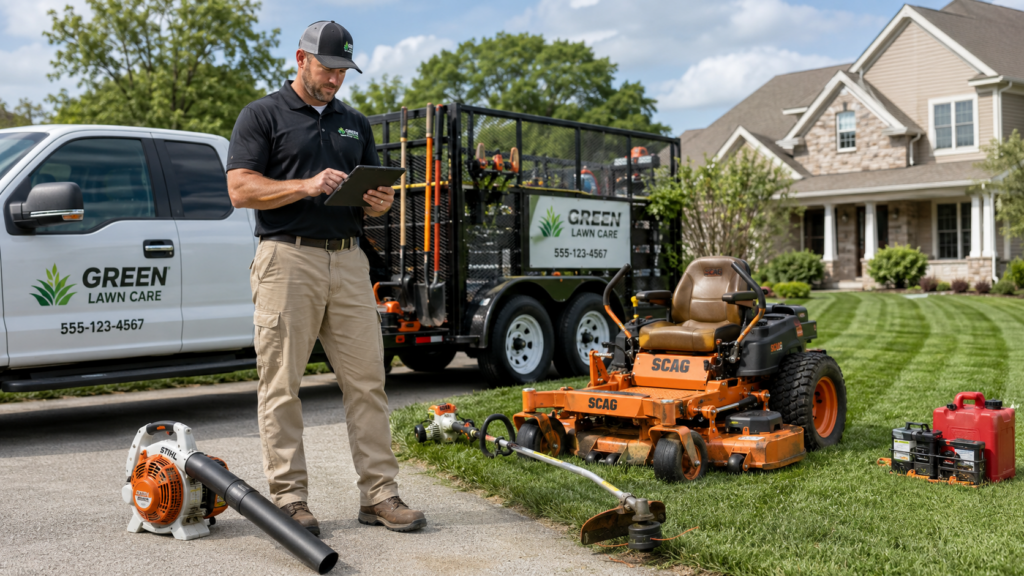
How much can a lawn care business make? The answer depends on your pricing, the number of lawns you service, your operating expenses, and the types of services you offer. A part-time lawn care business may generate a few thousand dollars each month, while an established full-time company can produce well into six figures in annual revenue.
However, revenue doesn’t tell the whole story. Two lawn care businesses can bring in the same amount of money but earn very different profits because of fuel costs, equipment maintenance, travel time, payroll, and other operating expenses.
Whether you’re just starting a lawn care business or looking for ways to increase your income, understanding how revenue, expenses, and profit work together is one of the keys to long-term success.
In this guide, you’ll learn how much a lawn care business can make, what affects your earnings, and practical ways to increase your profit.
Revenue vs. Profit: Understanding the Difference
Many new lawn care business owners focus only on how much money comes in each week.
While revenue is important, profit is what actually pays your bills and helps your business grow.
Revenue is the total amount customers pay you before expenses.
Profit is what’s left after you subtract all of your business costs.
For example, suppose you mow 25 lawns in one week at an average price of $60 per lawn.
25 × $60 = $1,500 Weekly Revenue
Now subtract your expenses:
- Fuel
- Equipment maintenance
- Truck expenses
- Insurance
- String trimmer line
- Mower blades
- Advertising
- Payment processing fees
If those expenses total $500, your profit would be:
$1,500 − $500 = $1,000 Profit
This is why tracking both revenue and expenses is essential. A busy schedule doesn’t always mean you’re earning as much as you think.
How Much Can a Lawn Care Business Make Per Day?
Daily revenue depends on two main factors:
- How many lawns you service
- Your average price per lawn
Here are a few examples.
| Lawns Per Day | Average Price | Daily Revenue |
|---|---|---|
| 5 | $50 | $250 |
| 6 | $60 | $360 |
| 8 | $65 | $520 |
| 10 | $70 | $700 |
Notice that increasing your average price by just $10 per lawn can have a significant impact on your daily revenue.
You don’t always need to mow more lawns to earn more money. Sometimes charging appropriately for your services is the better solution.
How Much Can a Lawn Care Business Make Per Month?
Monthly revenue depends on your daily schedule and how many days you work.
A simple formula is:
Average Price Per Lawn × Lawns Per Day × Workdays Per Month = Monthly Revenue
Example 1
Suppose you average:
- 6 lawns per day
- $60 per lawn
- 20 workdays per month
Calculation:
6 × $60 × 20 = $7,200 Monthly Revenue
Example 2
Now suppose your business grows to:
- 8 lawns per day
- $70 per lawn
- 20 workdays
Calculation:
8 × $70 × 20 = $11,200 Monthly Revenue
Remember that these numbers represent gross revenue before expenses.
Fuel, payroll, equipment repairs, and overhead still need to be deducted to determine your actual profit.
How Much Can a Lawn Care Business Make Per Year?
Annual revenue is simply your monthly revenue multiplied by 12.
| Monthly Revenue | Annual Revenue |
|---|---|
| $5,000 | $60,000 |
| $7,500 | $90,000 |
| $10,000 | $120,000 |
| $15,000 | $180,000 |
| $20,000 | $240,000 |
Many solo lawn care businesses eventually reach annual revenues of over $100,000 by building recurring customers, increasing prices, and offering additional services.
Again, revenue is not the same as take-home income. Profit depends on how well you control your expenses.
What Determines How Much You Can Make?
Several factors influence how much your lawn care business earns.
Average Price Per Lawn
One of the biggest factors is your average price.
Consider these examples:
- 10 lawns at $50 = $500
- 7 lawns at $75 = $525
The second business earns more money while completing fewer properties.
Higher prices often mean:
- Less fuel
- Less equipment wear
- Less travel
- Less physical labor
That’s why increasing your average ticket is often one of the fastest ways to improve profitability.
Number of Lawns Serviced
The number of properties you complete each day also affects your income.
However, more isn’t always better.
A schedule filled with small lawns spread across a large area can produce less profit than fewer properties located close together.
Efficient routing helps you:
- Reduce fuel costs
- Spend less time driving
- Complete more work
- Increase hourly earnings
Many successful lawn care businesses group customers by neighborhood or zip code to maximize efficiency.
Services You Offer
Basic mowing is only one source of income.
Many businesses increase their revenue by offering additional services such as:
- Lawn edging
- String trimming
- Leaf cleanup
- Hedge trimming
- Mulching
- Seasonal cleanups
- Aeration
- Overseeding
- Fertilization
- Weed control
Offering multiple services increases the value of each customer instead of relying only on mowing.
Recurring Customers
Recurring customers create predictable income.
Weekly or biweekly mowing schedules help stabilize cash flow and reduce marketing costs because you spend less time finding new customers.
Many successful lawn care businesses build their schedules around recurring maintenance accounts.
Seasonal Demand
Lawn care income changes throughout the year in many areas.
Spring and summer are often the busiest seasons, while fall may shift toward leaf cleanup and winter may bring slower demand.
Offering seasonal services such as leaf removal, gutter cleaning, or snow removal (where applicable) can help smooth out seasonal income changes.
Common Lawn Care Business Expenses
One of the biggest mistakes new lawn care business owners make is assuming every dollar they earn is profit.
While your business may bring in thousands of dollars each month, you also have ongoing expenses that reduce your take-home income.
Some of the most common lawn care business expenses include:
- Fuel
- Commercial mower maintenance
- String trimmer maintenance
- Blower maintenance
- Mower blades
- Trimmer line
- Oil and filters
- Truck maintenance
- Trailer maintenance
- Business insurance
- Vehicle insurance
- Advertising
- Website hosting
- Scheduling software
- Payment processing fees
- Accounting software
- Uniforms
- Safety equipment
- Taxes
Even small expenses can add up quickly over the course of a season.
For example, suppose your average operating cost is $18 per lawn and you service 180 lawns each month.
180 × $18 = $3,240 Monthly Operating Expenses
Understanding your average cost per lawn helps you build prices that keep your business profitable.
Profit Margin Example
Let’s look at a realistic example.
Suppose you charge $75 to mow a residential property.
Your estimated expenses are:
| Expense | Cost |
|---|---|
| Fuel | $4 |
| Equipment Wear | $6 |
| Insurance & Overhead | $8 |
| Payment Processing | $2 |
| Total Operating Expenses | $20 |
At first glance, it may seem like you made:
$75 − $20 = $55
However, don’t forget your labor.
Your time has value just like any employee.
Suppose the job takes one hour and you value your labor at $30 per hour.
Your total cost now becomes:
$20 + $30 = $50
Actual profit:
$75 − $50 = $25
Profit Margin:
$25 ÷ $75 = 33.3%
Many new business owners forget to include their own labor when calculating profit. Doing so gives you a much more realistic picture of how well your business is performing.
Residential vs. Commercial Lawn Care Income
Most lawn care businesses earn money from either residential customers, commercial properties, or a combination of both.
Residential Lawn Care
Residential customers typically need:
- Weekly mowing
- Biweekly mowing
- Trimming
- Edging
- Blowing off driveways and sidewalks
Advantages include:
- Easier to build relationships
- Faster payment
- Referral opportunities
- Flexible scheduling
The downside is that residential work often involves more travel between properties unless you build dense service routes.
Commercial Lawn Care
Commercial properties may include:
- Office buildings
- Apartment complexes
- Retail centers
- Medical offices
- Churches
- HOA common areas
- Industrial properties
Advantages include:
- Larger contracts
- Recurring monthly income
- Predictable schedules
- Long-term relationships
Commercial work may also require:
- Additional insurance
- Larger equipment
- Earlier start times
- Competitive bidding
Many successful lawn care businesses use residential work to build cash flow while gradually adding commercial accounts for stability.
Seasonal Income
Unlike some service businesses, lawn care income changes throughout the year.
Many companies are busiest during:
- Spring
- Late spring
- Summer
- Early fall
As temperatures cool, mowing may slow down.
Successful businesses often replace mowing income with seasonal services such as:
- Leaf cleanup
- Mulching
- Shrub trimming
- Fall cleanups
- Gutter cleaning
- Landscape maintenance
In colder climates, some businesses also offer snow removal during the winter months.
Offering multiple seasonal services helps create a more consistent income throughout the year.
How to Increase Your Lawn Care Income
Growing your business isn’t always about mowing more lawns.
Often, it’s about increasing the value of every customer.
Increase Your Average Ticket
Instead of offering only mowing, create service packages.
For example:
- Basic Mowing
- Mowing + Edging
- Complete Lawn Maintenance
- Premium Property Care
Customers often choose larger packages when they clearly understand the value.
Offer Additional Services
Upselling can significantly increase your annual revenue.
Popular add-on services include:
- Hedge trimming
- Mulch installation
- Weed control
- Aeration
- Overseeding
- Flower bed maintenance
- Shrub pruning
- Leaf removal
- Yard cleanups
Suppose you add just $40 in additional services to each customer.
If you service 250 customers each year:
250 × $40 = $10,000
That’s an additional $10,000 in annual revenue without finding new customers.
Build Dense Service Routes
Driving doesn’t generate income.
The less time you spend traveling between properties, the more lawns you can complete each day.
Grouping customers by neighborhood helps you:
- Reduce fuel costs
- Reduce equipment wear
- Complete more jobs
- Increase hourly profit
Many successful lawn care companies intentionally market to neighborhoods where they already have customers.
Build Recurring Customers
Recurring customers provide steady, predictable income.
Instead of constantly searching for new clients, focus on providing excellent service that keeps existing customers coming back year after year.
Repeat customers also become one of your best sources of referrals.
Review Your Prices Regularly
Fuel, insurance, equipment, and labor costs increase over time.
Review your pricing at least once each year to make sure your profit margins remain healthy.
Many business owners wait too long before increasing prices, which slowly reduces their profitability.
Can a Lawn Care Business Make Six Figures?
Yes.
Many lawn care businesses generate well over $100,000 per year in annual revenue.
For example:
Average Lawn Price:
$65
Lawns Per Day:
8
Workdays Per Month:
20
Monthly Revenue:
$65 × 8 × 20 = $10,400
Annual Revenue:
$10,400 × 12 = $124,800
Again, this represents gross revenue before expenses.
Your actual income depends on your pricing strategy, operating costs, labor, and business efficiency.
Many lawn care companies increase revenue even further by:
- Hiring additional crews
- Adding commercial contracts
- Expanding into nearby cities
- Offering landscape services
- Selling annual maintenance packages
Growth should always be managed carefully so expenses don’t outpace revenue.
Use Our Free Lawn Care Calculators
Our free calculators help you estimate pricing, income, expenses, and profitability before taking on new jobs.
Helpful calculators include:
- Lawn Care Pricing Calculator
- Lawn Care Profit Calculator
- Lawn Care Hourly Rate Calculator
- Lawn Care Cost Per Job Calculator
- Lawn Care Jobs Per Day Calculator
- Lawn Care Daily Income Calculator
- Lawn Care Monthly Income Calculator
- Lawn Care Break-Even Calculator
- Lawn Care Price Per Yard Size Calculator
- Lawn Care Price Per Acre Calculator
- Lawn Care Price Per Square Foot Calculator
These tools help you make pricing decisions based on real numbers instead of guesswork.
Frequently Asked Questions
How much can a lawn care business make in a year?
A lawn care business can generate anywhere from a few thousand dollars annually as a part-time business to well over $100,000 in yearly revenue as a full-time operation. Actual profit depends on pricing, expenses, and the number of properties serviced.
Is lawn care a profitable business?
Yes. Lawn care can be very profitable when prices are based on labor, fuel, equipment costs, travel, overhead, and desired profit instead of simply matching competitors’ prices.
How many lawns can one person mow in a day?
Many solo lawn care operators complete between 5 and 10 lawns per day, depending on property size, travel time, equipment, and the services included.
What is the best way to make more money in lawn care?
One of the fastest ways to increase income is by raising your average customer value through service packages, recurring maintenance, premium add-on services, and efficient route planning.
Final Thoughts
How much can a lawn care business make? The answer depends on much more than the number of lawns you mow. Pricing, operating expenses, efficiency, customer retention, and the services you offer all play a major role in determining your income.
Instead of focusing only on revenue, track your operating costs, understand your profit margins, and review your pricing regularly. Small improvements—such as increasing your average ticket, reducing travel time, or adding seasonal services—can significantly increase your yearly earnings.
If you’re planning to start or grow a lawn care business, use our free Lawn Care Calculators to estimate pricing, profit, daily income, monthly revenue, and business expenses. They can help you make informed decisions and build a lawn care business that is both profitable and sustainable.
Disclaimer: The calculators, guides, and estimates provided on Service Calculator Hub are for informational and educational purposes only. Actual prices, costs, profits, and income may vary based on location, experience, market conditions, materials, labor costs, and individual business circumstances. Always conduct your own research and use your professional judgment when pricing services or making business decisions.