
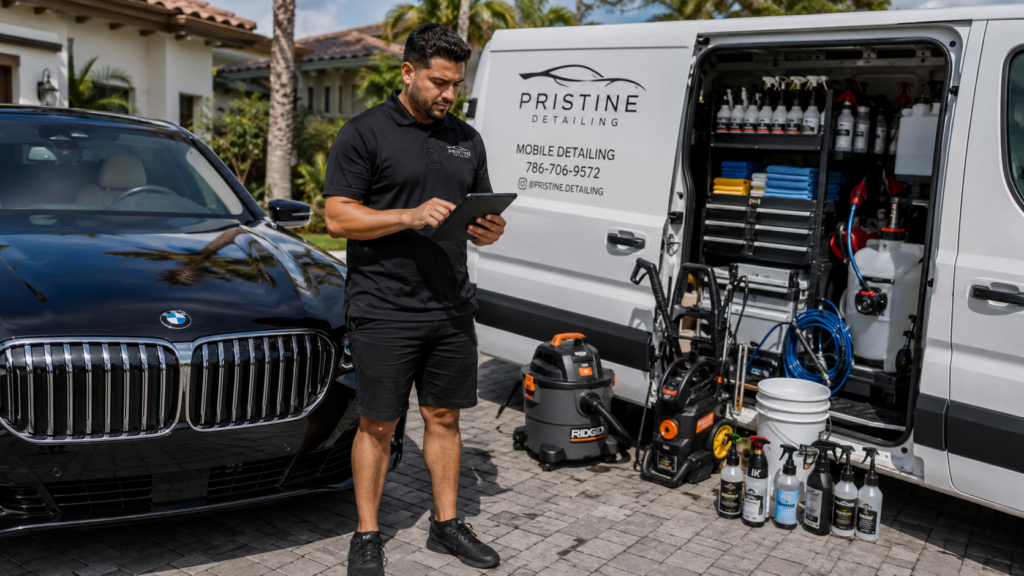
How much can a mobile detailing business make? The answer depends on your pricing, the number of jobs you complete, your expenses, and the services you offer. A mobile detailing business can earn anywhere from a few hundred dollars per week as a part-time side business to several thousand dollars per week as a full-time operation..
A solo mobile detailer charging an average of $200 per job and completing two jobs per day could bring in about $2,000 per week before expenses. However, revenue is not the same as profit. You must subtract supplies, fuel, insurance, equipment, taxes, advertising, and other business costs.
This guide explains how much a mobile detailing business can make and what affects your actual take-home income.
Mobile Detailing Revenue vs. Profit
Before estimating your income, it is important to understand the difference between revenue and profit.
Revenue is the total amount customers pay your business.
Profit is the money left after you subtract all business expenses.
For example, suppose you complete 10 detailing jobs in one week at an average price of $200.
10 jobs × $200 = $2,000 in weekly revenue
If your weekly expenses total $700:
$2,000 revenue − $700 expenses = $1,300 profit
The $2,000 may sound impressive, but the $1,300 profit gives you a better picture of what the business actually earned.
How Much Can a Solo Mobile Detailer Make?
A solo operator may complete one to three vehicles per day, depending on the type of services offered.
Basic washes may take less time, while full details, paint correction, and heavily soiled interiors may take several hours.
Here are a few simple examples.
| Business Level | Jobs per Day | Average Job Price | Days per Week | Weekly Revenue |
|---|---|---|---|---|
| Part-Time Starter | 1 | $150 | 3 | $450 |
| Full-Time Beginner | 2 | $175 | 5 | $1,750 |
| Established Solo Detailer | 2 | $250 | 5 | $2,500 |
| Premium Solo Detailer | 2 | $350 | 5 | $3,500 |
These amounts are gross revenue before expenses.
A solo detailer may earn more by increasing average job value instead of trying to complete as many vehicles as possible.
For example, adding services such as pet hair removal, stain treatment, clay bar service, wax, headlight restoration, or ceramic protection can increase the amount earned from each customer.
How Much Can a Mobile Detailing Business Make Per Month?
Monthly revenue depends on how many jobs you complete and what you charge.
A simple formula is:
Average price per job × jobs per day × workdays per month = monthly revenue
Example 1: Part-Time Business
Suppose you detail:
- 1 vehicle per day
- 3 days per week
- 12 days per month
- Average job price of $175
$175 × 1 × 12 = $2,100 in monthly revenue
If expenses equal $700, estimated profit would be:
$2,100 − $700 = $1,400
Example 2: Full-Time Solo Business
Suppose you detail:
- 2 vehicles per day
- 5 days per week
- 20 days per month
- Average job price of $225
$225 × 2 × 20 = $9,000 in monthly revenue
If expenses total $3,000:
$9,000 − $3,000 = $6,000 in estimated profit
Example 3: Premium Mobile Detailing Business
Suppose you complete:
- 2 vehicles per day
- 20 days per month
- Average job price of $350
$350 × 2 × 20 = $14,000 in monthly revenue
If monthly expenses equal $4,500:
$14,000 − $4,500 = $9,500 in estimated profit
These examples show why pricing and service mix matter so much. A business does not always need more customers to increase income. It may be able to earn more by offering higher-value services.
How Much Can a Mobile Detailing Business Make Per Year?
Annual revenue can vary widely.
A part-time operator may bring in less than $30,000 per year, while a busy full-time business may generate well over $100,000 in yearly revenue.
Here are a few examples:
| Average Monthly Revenue | Estimated Annual Revenue |
|---|---|
| $3,000 | $36,000 |
| $6,000 | $72,000 |
| $9,000 | $108,000 |
| $12,000 | $144,000 |
| $15,000 | $180,000 |
Remember that these numbers represent revenue, not guaranteed take-home pay.
Your actual profit will depend on:
- Supply costs
- Fuel
- Vehicle expenses
- Equipment
- Insurance
- Advertising
- Taxes
- Employee wages
- Payment processing fees
- Repairs and maintenance
What Affects Mobile Detailing Income?
Several factors determine how much a mobile detailing business can make.
Average Price Per Job
Your average job value has a major effect on income.
A business charging $100 per job must complete far more vehicles than a business averaging $250 per job.
For example:
- 10 jobs at $100 = $1,000
- 5 jobs at $200 = $1,000
- 4 jobs at $250 = $1,000
Higher prices can reduce the number of jobs needed to reach your income goal.
However, your prices should reflect the quality of your service, local market, experience, and business expenses.
Number of Jobs Per Day
The number of vehicles you can complete depends on your service type.
A basic maintenance detail may take one or two hours. A full interior and exterior detail may take four or more hours.
Do not schedule more jobs than you can complete well. Rushing can lead to poor results, unhappy customers, and negative reviews.
A realistic daily schedule may include:
- Three small maintenance jobs
- Two standard full details
- One large or premium detail
Services Offered
Premium services can increase revenue without adding a large number of customers.
Possible add-on services include:
- Pet hair removal
- Stain extraction
- Odor treatment
- Headlight restoration
- Engine bay cleaning
- Clay bar treatment
- Wax or sealant
- Paint correction
- Ceramic coating
- Water spot removal
Your add-on prices should cover the extra time, products, equipment, and skill required.
Vehicle Size
Larger vehicles usually take more time and use more products.
Many mobile detailing businesses charge more for:
- SUVs
- Pickup trucks
- Vans
- Three-row vehicles
- Commercial vehicles
A clear size-based price structure can help protect your hourly earnings.
Vehicle Condition
A lightly used vehicle may take much less time than one with:
- Heavy pet hair
- Food spills
- Sand
- Mud
- Smoke odors
- Deep stains
- Excessive trash
You may need to charge a condition fee when the job requires more work than a standard package includes.
Local Market
Prices vary by location.
Businesses in higher-cost areas may be able to charge more, but they may also face higher fuel, insurance, labor, and advertising costs.
Research local competitors, but do not copy their prices without checking your own expenses.
Travel Time
Mobile detailing requires driving between customers.
Long travel distances can reduce the number of jobs you complete each day.
A tight service route can improve income by reducing:
- Fuel use
- Driving time
- Vehicle wear
- Gaps between appointments
You may also charge a travel fee outside your normal service area.
Weather and Seasonality
Weather can affect mobile detailing income.
Rain, freezing temperatures, extreme heat, and short winter days may reduce the number of jobs you can complete.
Some businesses stay busy year-round by offering:
- Interior-only packages
- Fleet detailing
- Dealership work
- Maintenance plans
- Garage-based services
- Gift certificates
Planning for slower months can help protect your yearly income.
Common Mobile Detailing Expenses
To estimate profit correctly, you must track your expenses.
Common costs include:
- Cleaning chemicals
- Microfiber towels
- Brushes and applicators
- Vacuum maintenance
- Water
- Fuel
- Vehicle maintenance
- Pressure washer repairs
- Generator fuel
- Insurance
- Business license
- Advertising
- Website expenses
- Scheduling software
- Payment processing fees
- Uniforms
- Taxes
Some expenses are easy to connect to a specific job. Others should be divided across all jobs.
For example, if your business insurance costs $1,200 per year and you complete 300 jobs, the insurance expense equals about $4 per job.
$1,200 ÷ 300 = $4 per job
Small costs add up, so they should not be ignored.
Mobile Detailing Profit Margin Example
Suppose your average full-detail price is $250.
Your estimated cost per job may look like this:
| Expense | Amount |
|---|---|
| Supplies | $20 |
| Fuel and travel | $15 |
| Equipment allowance | $15 |
| Insurance and overhead | $25 |
| Labor value | $100 |
| Total Estimated Cost | $175 |
Estimated profit:
$250 − $175 = $75
Profit margin:
$75 ÷ $250 = 30%
This means 30% of the selling price remains after the estimated costs are paid.
If you complete 40 similar jobs per month:
40 × $75 = $3,000 in monthly profit
This is why knowing your cost per car is so important.
How to Increase Mobile Detailing Income
You do not always need to work longer hours to make more money.
Raise Your Average Job Value
Add premium services or create higher-priced packages.
For example, instead of selling only a $150 basic detail, offer:
- Basic Detail: $150
- Full Detail: $250
- Premium Detail: $375
A clear package structure can help customers choose a higher-value service.
Offer Add-On Services
Small add-ons can increase each ticket.
Examples include:
- Pet hair removal
- Seat shampooing
- Headlight restoration
- Spray wax
- Odor treatment
- Engine bay cleaning
Even an extra $25 per customer can make a large difference.
If you serve 40 customers per month:
40 × $25 = $1,000 in additional monthly revenue
Create Maintenance Plans
Recurring customers can make income more predictable.
You might offer:
- Monthly maintenance details
- Every-other-month service
- Fleet plans
- Family vehicle packages
Maintenance jobs are often faster because the vehicles do not become as dirty between visits.
Improve Route Planning
Schedule customers in the same area on the same day.
This reduces travel time and creates room for more paid work.
For example, saving 30 minutes between appointments may allow you to add another small job or finish earlier.
Reduce Supply Waste
Track how much product you use per vehicle.
Using too much chemical can reduce profit without improving results.
Standard dilution ratios and measured bottles can help control supply costs.
Increase Prices When Needed
Your prices may need to increase as:
- Fuel costs rise
- Supply prices increase
- Your experience improves
- Demand grows
- Your reviews get stronger
- Your schedule fills up
Regular price reviews help prevent your profit from shrinking.
Track Profit, Not Just Revenue
A busy schedule does not always mean a profitable business.
Track:
- Revenue per job
- Cost per car
- Profit per job
- Average job value
- Jobs per day
- Monthly profit
These numbers show which services are worth offering and which ones may need higher prices.
Can a Mobile Detailing Business Reach Six Figures?
Yes, a mobile detailing business can reach six figures in annual revenue, but it usually requires strong pricing, steady demand, efficient scheduling, and control over expenses.
For example:
- Average job price: $250
- Jobs per day: 2
- Workdays per month: 20
Monthly revenue:
$250 × 2 × 20 = $10,000
Annual revenue:
$10,000 × 12 = $120,000
That does not mean the owner takes home $120,000. Business expenses and taxes still need to be paid.
A business may also reach higher revenue by adding employees, additional vehicles, fleet accounts, or premium services.
Growth should be planned carefully. More revenue can also create more payroll, insurance, equipment, and management costs.
Part-Time vs. Full-Time Mobile Detailing Income
A mobile detailing business can work well as either a side business or a full-time operation.
Part-Time Business
A part-time detailer may work evenings or weekends.
Possible advantages include:
- Lower financial risk
- Time to build reviews
- Extra household income
- Ability to test pricing
- Gradual equipment purchases
The main limitation is having fewer appointment times available.
Full-Time Business
A full-time operator may have more time for:
- Daily appointments
- Customer follow-up
- Marketing
- Fleet accounts
- Recurring plans
- Premium services
However, full-time income may change by season, so it is important to build savings and track monthly expenses.
Use Our Free Mobile Detailing Calculators
Our free calculators can help you estimate revenue, profit, job capacity, and income goals.
Helpful tools include:
- Mobile Detailing Daily Income Calculator
- Mobile Detailing Monthly Income Calculator
- Mobile Detailing Jobs Per Day Calculator
- Mobile Detailing Profit Calculator
- Mobile Detailing Cost Per Car Calculator
- Mobile Detailing Pricing Calculator
- Mobile Detailing Hourly Rate Calculator
- Mobile Detailing Break-Even Calculator
Use these tools to test different prices and job schedules before setting your income goals.
Frequently Asked Questions
How much can a mobile detailing business make per month?
A part-time business may generate a few thousand dollars per month, while a busy full-time operation may bring in $8,000 to $15,000 or more in monthly revenue. Actual profit depends on expenses, prices, and job volume.
How many cars can a mobile detailer complete per day?
Many solo detailers complete one to three vehicles per day. The exact number depends on vehicle condition, package type, travel time, and whether the detailer works alone or with a helper.
Is mobile detailing profitable?
Mobile detailing can be profitable when prices cover labor, supplies, travel, equipment, overhead, and taxes. Profitability depends more on accurate pricing and cost control than on revenue alone.
Can mobile detailing become a full-time business?
Yes. Many owners turn mobile detailing into a full-time business by building repeat customers, offering premium services, increasing average job value, and scheduling work efficiently.
Final Thoughts
How much a mobile detailing business can make depends on more than the number of cars you clean.
Your income is affected by:
- Average price per job
- Jobs completed
- Services offered
- Travel time
- Vehicle condition
- Business expenses
- Profit margin
- Seasonal demand
A solo operator may earn a useful part-time income or build a full-time business with six-figure annual revenue. The key is to understand the difference between revenue and profit.
Set prices that cover your complete costs, track what each job earns, and focus on services that provide the best return for your time.
Use our free mobile detailing calculators to estimate your daily income, monthly revenue, expenses, and profit before setting your next business goal.
Disclaimer: The calculators, guides, and estimates provided on Service Calculator Hub are for informational and educational purposes only. Actual prices, costs, profits, and income may vary based on location, experience, market conditions, materials, labor costs, and individual business circumstances. Always conduct your own research and use your professional judgment when pricing services or making business decisions.