
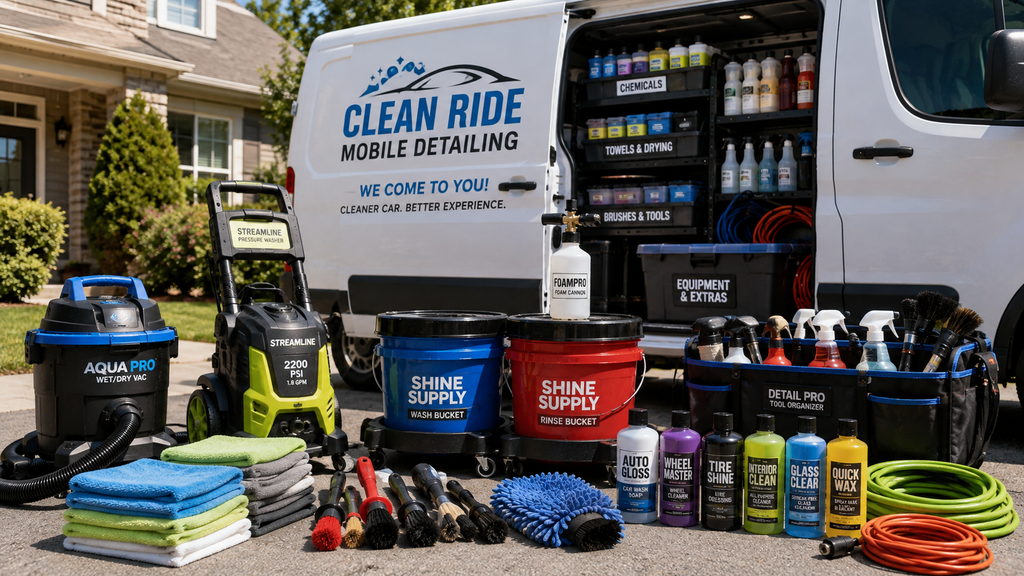
A mobile detailing equipment checklist can help you figure out what you actually need to start detailing cars without spending thousands of dollars on equipment you may not use.
Starting a mobile detailing business can feel expensive when you see professional setups with large water tanks, generators, pressure washers, extractors, polishers, and shelves full of chemicals. The good news is that you don’t need everything on day one.
A beginner can start with the essential equipment needed to safely wash, clean, and detail vehicles. As your customer base grows, you can invest in better equipment and add services that require specialized tools.
This guide breaks down the essential mobile detailing equipment for beginners, what you can wait to buy, and how to build your setup without overspending.
This article contains affiliate links. If you purchase through one of these links, we may earn a commission at no additional cost to you.
What Equipment Do You Need to Start Mobile Detailing?
At a minimum, a mobile detailer needs equipment for:
- Washing vehicles
- Cleaning wheels and tires
- Vacuuming interiors
- Cleaning interior surfaces
- Cleaning windows
- Drying vehicles
- Applying basic protection
- Organizing and transporting supplies
Your exact equipment will depend on the services you plan to offer.
For example, a business offering basic interior and exterior detailing doesn’t need the same equipment as a detailer offering paint correction and ceramic coatings.
Start by deciding what services you want to sell.
Then buy the equipment needed to perform those services well.
Beginner Mobile Detailing Equipment Checklist
Here is a quick overview of the basic equipment and supplies you may need.
Exterior Equipment
- Pressure washer or garden hose
- Pressure washer hose
- Spray nozzle
- Foam cannon or foam sprayer
- Wash buckets
- Grit guards
- Wash mitts
- Wheel brushes
- Tire brushes
- Detailing brushes
- Drying towels
- Microfiber towels
Interior Equipment
- Wet/dry vacuum
- Vacuum attachments
- Interior detailing brushes
- Microfiber towels
- Spray bottles
- Carpet brushes
- Glass towels
Cleaning Products
- Car wash soap
- Wheel cleaner
- Tire cleaner
- Interior cleaner
- Glass cleaner
- Carpet and upholstery cleaner
- Tire dressing
- Spray wax or sealant
Business and Safety Equipment
- Extension cords
- Hose reels or storage
- Chemical-resistant gloves
- Safety glasses
- Storage bins
- Towel and chemical organizers
- First-aid kit
You don’t necessarily need to purchase everything at once.
Let’s look at the most important items individually.
1. Pressure Washer
A pressure washer is one of the most useful pieces of equipment in a mobile detailing setup.
It helps remove:
- Dirt
- Mud
- Road grime
- Loose debris
- Soap and cleaning products
A pressure washer can also make exterior washing faster than using a standard garden hose.
For mobile detailing, you generally don’t need the largest or most powerful pressure washer available. You need enough cleaning power to wash vehicles efficiently without using excessive pressure that could damage paint or trim.
When comparing pressure washers, consider:
- Water flow
- Pressure
- Hose length
- Size
- Weight
- Reliability
- Replacement parts
Electric pressure washers can be a practical starting point for beginners who expect to have access to customer electricity.
A gas-powered unit provides more independence but may cost more and require additional maintenance.
Product Option: Sun Joe SPX3000 Electric Pressure Washer
The Sun Joe SPX3000 is an electric pressure washer worth considering for a beginner setup. An electric unit can be easier to transport and maintain than a larger gas-powered machine, making it a practical starting point for detailers who have access to electricity at the job site.
2. Pressure Washer Hose
Don’t overlook the hose.
A longer pressure washer hose lets you move around a vehicle without constantly moving the pressure washer itself.
This becomes especially helpful when working on:
- Trucks
- SUVs
- Large driveways
- Multiple vehicles
A quality hose also reduces frustration caused by kinking and tangling.
When choosing a replacement or upgraded hose, make sure it’s compatible with your pressure washer and fittings.
You don’t necessarily need a professional hose reel when you first start. A good hose and an organized way to store it are enough for a beginner setup.
3. Foam Cannon or Foam Sprayer
A foam cannon connects to a pressure washer and applies a layer of foamy soap across the vehicle.
It can help:
- Loosen dirt
- Lubricate the paint
- Improve washing efficiency
- Reduce direct contact with dirt
It also gives customers the professional detailing experience they often expect.
If you don’t have a pressure washer yet, a pump foam sprayer can provide a lower-cost alternative.
A foam cannon is useful, but you don’t need an expensive professional model when you’re first getting started.
Product Option: Tool Daily Foam Cannon
The Tool Daily Foam Cannon is a straightforward option for someone putting together a first detailing setup. Before ordering any foam cannon, check the included fittings to make sure they’ll work with your pressure washer.
4. Wash Buckets and Grit Guards
A basic detailing setup should include at least two buckets.
One bucket holds your wash solution.
The second holds clean rinse water.
This is commonly called the two-bucket wash method.
Using separate buckets helps reduce the amount of dirt transferred back onto the vehicle.
Adding grit guards to the bottom of your buckets can help keep dirt and debris away from your wash mitt.
Product Option: Chemical Guys Cyclone Dirt Trap
The Chemical Guys Cyclone Dirt Trap is designed to sit at the bottom of a wash bucket and help separate dirt from your wash water.
You still need appropriately sized buckets, so check the dimensions before purchasing several for your setup.
5. Wash Mitts
Avoid washing vehicles with household sponges or old towels.
Use a quality microfiber or specialized car wash mitt designed for automotive paint.
A good wash mitt:
- Holds plenty of soap
- Glides across paint
- Picks up dirt
- Helps reduce scratching
Keep multiple mitts available so you’re not forced to continue using a heavily soiled one.
You may also want separate mitts for lower body panels, which are usually much dirtier than the upper portions of the vehicle.
Product Option: Meguiar’s Microfiber Wash Mitt
The Meguiar’s Microfiber Wash Mitt is one option for a beginner detailing kit. Having more than one wash mitt also makes it easier to keep the dirtiest areas of the vehicle separate from cleaner painted surfaces.
6. Microfiber Towels
Microfiber towels are one of the supplies you’ll use most often.
They can be used for:
- Interior cleaning
- Exterior cleaning
- Wax removal
- Glass cleaning
- Door jambs
- Final touch-ups
However, don’t use the same towels for everything.
Consider separating towels by purpose.
For example:
- Paint towels
- Interior towels
- Glass towels
- Wheel towels
- Dirty-job towels
This reduces the chance of transferring grease, chemicals, or dirt onto delicate surfaces.
You don’t need hundreds of towels when starting, but having enough clean towels to complete several vehicles before doing laundry will make your work much easier.
Product Option: The Rag Company Eagle Edgeless 500 Microfiber Towels
The Eagle Edgeless 500 towels from The Rag Company are a higher-pile microfiber option that can be useful for paint-related detailing tasks.
You can still purchase less expensive microfiber towels for interiors, door jambs, wheels, and other dirtier jobs. Using premium towels for every task can unnecessarily increase your supply costs.
7. Drying Towels
A dedicated microfiber drying towel can make drying a vehicle faster and reduce the need to repeatedly wipe the same area.
Traditional household bath towels aren’t designed specifically for automotive finishes.
Look for a drying towel that is:
- Soft
- Highly absorbent
- Large enough for efficient drying
- Designed for automotive use
You may eventually add a vehicle dryer or blower, but quality drying towels are enough for most beginners.
Product Option: The Rag Company The Liquid8r Drying Towel
The Rag Company Liquid8r is a dedicated automotive drying towel worth considering if you want to keep your drying towels separate from the microfiber towels used for cleaning and finishing work.
8. Wheel and Tire Brushes
Wheels and tires often contain some of the heaviest dirt on a vehicle.
You should have dedicated brushes for this area rather than using your paint-cleaning tools.
Useful brushes include:
- Tire brush
- Wheel face brush
- Wheel barrel brush
- Small detailing brush
Keep wheel equipment separate from anything that touches the vehicle’s paint.
Brake dust and road grime can be abrasive, so color-coding or clearly separating your wheel tools can help prevent accidental cross-use.
Product Option: Chemical Guys Wheelie All Exterior Surface and Wheel Brush
The Chemical Guys Wheelie All Exterior Surface and Wheel Brush is one option for cleaning wheels and other durable exterior surfaces.
As your business grows, you may want several wheel brushes in different shapes and sizes to reach wheel faces, barrels, tires, and tight areas.
9. Wet/Dry Vacuum
A good vacuum is essential if you plan to offer interior detailing.
You’ll use it to remove:
- Dirt
- Sand
- Food crumbs
- Pet hair
- Leaves
- Small debris
A wet/dry shop vacuum is popular for detailing because it’s built for heavier cleaning than a typical household vacuum.
When choosing one, consider:
- Suction
- Hose length
- Attachment selection
- Size
- Storage
- Power requirements
A large vacuum may offer more capacity, but a compact model can be much easier to transport in a mobile setup.
Product Option: RIDGID 4-Gallon Portable Wet/Dry Shop Vacuum
A RIDGID 4-Gallon Portable Wet/Dry Shop Vacuum is the type of compact shop vacuum that can make sense for a mobile business where storage space matters.
Before purchasing, check the exact model’s included attachments and hose size. You may want to add automotive-specific attachments later.
10. Vacuum Attachments
The attachments can be almost as important as the vacuum itself.
Vehicles contain tight areas that are difficult to reach with a standard vacuum hose.
Helpful attachments include:
- Crevice tool
- Brush attachment
- Narrow nozzle
- Flexible attachment
These help clean areas such as:
- Between seats
- Under seats
- Seat tracks
- Cup holders
- Door pockets
- Tight carpet edges
Before buying a separate attachment kit, check what comes with your vacuum.
If your vacuum already includes a good crevice tool and brush, you may not need additional attachments immediately.
11. Interior Detailing Brushes
Small detailing brushes help clean areas that microfiber towels can’t easily reach.
They work well around:
- Air vents
- Buttons
- Cup holders
- Dashboard seams
- Door panels
- Center consoles
You may want several brush sizes.
Keep brushes used on dirty exterior areas separate from brushes used inside vehicles.
Product Option: Detail Factory Ultra-Soft Detailing Brush
The Detail Factory Ultra-Soft Detailing Brush is an option for delicate interior detailing work, particularly around areas where you don’t want to use a stiff cleaning brush.
You can add firmer brushes later for carpets and tougher surfaces.
12. Spray Bottles
Professional spray bottles are inexpensive but important.
You’ll use them for products such as:
- Interior cleaner
- Glass cleaner
- Wheel cleaner
- Carpet cleaner
- All-purpose cleaner
Clearly label every bottle.
Never rely on remembering what’s inside based on the bottle’s appearance.
If you dilute professional detailing chemicals, labeling the bottle with the product name and dilution ratio can also help you maintain consistent results.
Product Option: Zep Professional Sprayer Bottle
A Zep Professional Sprayer Bottle is one basic option for keeping frequently used detailing solutions organized.
Always make sure the bottle and sprayer are compatible with the chemical you’re putting inside them, and follow the chemical manufacturer’s storage and handling instructions.
13. Basic Detailing Chemicals
You don’t need dozens of chemicals to start a mobile detailing business.
A simple beginner collection may include:
- Car wash soap
- All-purpose cleaner
- Interior cleaner
- Glass cleaner
- Wheel and tire cleaner
- Carpet and upholstery cleaner
- Tire dressing
- Spray wax or paint sealant
Start with products you understand and know how to use safely.
As you gain experience, you can add specialized products for problems such as:
- Water spots
- Iron contamination
- Tree sap
- Tar
- Heavy stains
- Odors
Buying every specialty chemical before you have customers who need it can unnecessarily increase your startup costs.
For chemicals, always follow the manufacturer’s instructions for dilution, surfaces, storage, and personal protective equipment.
14. Extension Cords
If you plan to use customer electricity, you’ll need extension cords that are appropriate for your equipment.
They may be needed for your:
- Vacuum
- Pressure washer
- Extractor
- Polisher
- Other electrical equipment
Don’t choose an extension cord based only on length.
The cord needs to be properly rated for the electrical load, equipment, and environment where you’re using it. Follow the equipment manufacturer’s requirements rather than assuming one cord will work safely with every machine.
Also keep cords positioned so they don’t create trip hazards across sidewalks, driveways, or areas where customers may walk.
15. Storage and Organization
Organization may not seem as important as a pressure washer or vacuum, but it can have a major effect on how efficiently you work.
Useful storage options include:
- Plastic storage bins
- Chemical racks
- Towel containers
- Tool bags
- Shelving
- Hose storage
- Small parts organizers
Keep clean towels separate from dirty ones.
Secure chemicals and equipment so they don’t tip over or move around while you’re driving.
An organized vehicle also makes it easier to see when supplies are running low.
You don’t need an expensive custom van or trailer setup when you’re starting. Basic storage containers can work until you know exactly how you want your mobile setup organized.
Equipment You Don’t Necessarily Need on Day One
It’s easy to see professional detailing setups online and assume you need everything before taking your first customer.
You don’t.
Depending on the services you offer, you may be able to wait before purchasing:
- Water tank
- Generator
- Carpet extractor
- Steam cleaner
- Air compressor
- Professional vehicle dryer
- DA polisher
- Paint thickness gauge
- Large hose reels
- Expensive shelving systems
- Ceramic coating equipment
These tools can be valuable, but they aren’t necessary for every beginner.
Start with equipment that allows you to provide the services you’re selling today.
Then let the revenue from your business help pay for upgrades.
Should You Buy a Water Tank When Starting?
A water tank is one of the first major upgrades many mobile detailers consider.
Having your own water supply gives you more flexibility because you don’t have to depend on a customer’s outdoor faucet.
However, a water tank also adds:
- Startup cost
- Vehicle weight
- Plumbing
- Pump requirements
- Storage requirements
Water weighs about 8.3 pounds per gallon. That means even a 100-gallon tank can add more than 800 pounds of water before you account for the tank, equipment, chemicals, passengers, and everything else you’re carrying.
Before installing a tank, check your vehicle’s payload capacity and make sure your complete setup can safely handle the additional weight.
If your early customers usually have accessible water, you may be able to start without a tank and add one later.
Should You Buy a Generator?
A generator allows you to operate electrical equipment when customer power isn’t available.
This can make your mobile setup more independent.
However, generators also add:
- Purchase cost
- Fuel expense
- Maintenance
- Noise
- Storage requirements
You also need a generator capable of safely powering the equipment you intend to use.
If most of your early customers can provide electricity, a generator may not be necessary immediately.
Once you’re consistently booking jobs where access to electricity is uncertain, it may become a worthwhile investment.
Do You Need a Carpet Extractor?
A carpet extractor can be a valuable upgrade if you plan to offer deeper interior detailing.
An extractor sprays a cleaning solution into carpet or upholstery and then removes the dirty solution with suction.
It can be useful for:
- Carpet stains
- Cloth seats
- Floor mats
- Spills
- Heavily soiled interiors
However, you don’t necessarily need an extractor before booking your first customer.
If you’re starting with basic interior cleaning, a wet/dry vacuum, brushes, microfiber towels, and quality cleaning products may be enough.
Once customers begin requesting deeper carpet and upholstery cleaning, an extractor becomes easier to justify.
Product Option: BISSELL Little Green Pro Commercial Spot Cleaner
The BISSELL Little Green Pro Commercial Spot Cleaner is a compact option to consider for a mobile detailing setup where storage space matters.
A smaller extractor won’t replace every piece of professional upholstery-cleaning equipment, but it can provide a more affordable entry point for a beginner who wants to add deeper interior cleaning without immediately investing in a large machine.
Do You Need a Steam Cleaner?
A steam cleaner is another tool you can add as your interior detailing services grow.
Steam can be useful for cleaning certain areas such as:
- Cup holders
- Door panels
- Hard interior surfaces
- Tight spaces
- Some upholstery and carpet applications
However, steam isn’t appropriate for every material or surface.
Always use the correct attachments and follow the vehicle and equipment manufacturer’s recommendations. Excessive heat or moisture can damage certain interior materials.
For that reason, beginners should learn proper steam-cleaning techniques before using a steamer on customer vehicles.
Product Option: McCulloch MC1385 Deluxe Canister Steam Cleaner
The McCulloch MC1385 Deluxe Canister Steam Cleaner is one option to consider when you’re ready to add steam cleaning to your detailing services. It includes multiple attachments, which can be useful when working around different areas of a vehicle.
A steamer is an upgrade rather than a day-one requirement, so I would prioritize a good vacuum and basic interior tools first if your startup budget is limited.
Do You Need a DA Polisher?
A dual-action, or DA, polisher allows you to offer more advanced exterior services.
Depending on your skill level and the products you use, machine polishing can help address:
- Light swirl marks
- Minor paint imperfections
- Oxidation
- Dull paint
- Light scratches
Paint correction can also increase your average job price because it’s a more specialized service than a basic wash and wax.
However, buying a polisher doesn’t automatically mean you’re ready to offer paint correction professionally.
Practice proper polishing techniques before using a machine on customer vehicles. You’ll also need to learn about:
- Polishing pads
- Compounds
- Polishes
- Paint condition
- Machine speed
- Proper preparation
Product Option: Griot’s Garage G9 Random Orbital Polisher
The Griot’s Garage G9 Random Orbital Polisher is a DA polisher to consider when you’re ready to move beyond basic exterior detailing.
You’ll also need compatible polishing pads and products, so include those costs when deciding whether you’re ready to add paint correction to your service menu.
Do You Need an Automotive Blower?
Drying towels are enough for a beginner, but a dedicated blower can make drying faster and help remove trapped water from difficult areas.
A blower can be especially useful around:
- Mirrors
- Grilles
- Emblems
- Door handles
- Wheels
- Trim
- Body seams
Water often hides in these areas and drips onto the vehicle after you’ve already dried it.
A blower can also reduce how much physical contact is needed during drying.
Product Option: Adam’s Air Cannon Car Dryer
The Adam’s Air Cannon Car Dryer is a dedicated vehicle-drying option to consider as your business grows.
This is another upgrade rather than a beginner necessity. If you’re trying to keep startup costs low, invest in quality drying towels first and add a blower when your workload makes the time savings worthwhile.
Do You Need an Air Compressor?
Compressed air can be useful for removing dirt and debris from hard-to-reach interior areas.
Detailers may use compressed air around:
- Seat tracks
- Carpet edges
- Air vents
- Center consoles
- Under seats
- Tight seams
However, an air compressor adds another piece of equipment that requires space and power.
For a basic beginner setup, detailing brushes and vacuum attachments can handle many of these areas.
An air compressor becomes more useful as you begin doing higher-volume interior work or adding specialized air-powered detailing tools.
Because the right compressor depends heavily on the tools you intend to run, I wouldn’t choose one simply because it’s popular. Check the air requirements of your equipment before purchasing a compressor.
Can You Start Mobile Detailing Without Your Own Water and Electricity?
Yes.
One of the simplest ways to reduce your mobile detailing startup costs is to use customer-provided water and electricity when available.
You can tell customers when they book that you need access to:
- An outdoor water connection
- An electrical outlet
This allows you to begin with a much simpler setup.
You may not initially need:
- A large water tank
- Water pump
- Generator
- Complex plumbing
- Large trailer
The disadvantage is that your business depends on the customer’s utilities.
As your business grows, becoming self-contained can allow you to work in more locations.
The important thing is that you don’t need to build the ultimate mobile detailing rig before earning your first dollar.
Start with what you need to serve your first customers safely and professionally.
Mobile Detailing Safety Equipment
Safety equipment shouldn’t be an afterthought.
Detailing involves chemicals, electrical equipment, water, slippery surfaces, and repetitive physical work.
Your setup may include:
- Chemical-resistant gloves
- Safety glasses
- Closed-toe, slip-resistant shoes
- Hearing protection when appropriate
- First-aid kit
- Properly labeled chemical bottles
Always read the labels and Safety Data Sheets for the chemicals you use and follow the manufacturer’s instructions for handling, dilution, storage, and personal protective equipment.
You should also keep electrical connections protected from water and use equipment according to manufacturer instructions.
Professional detailing isn’t just about producing a clean vehicle. It’s also about working safely.
How to Organize Your Mobile Detailing Setup
You don’t need a custom van or trailer to look professional.
A simple, organized setup can work well when you’re starting.
Try dividing your equipment into categories.
Exterior Cleaning
Keep items such as:
- Wash mitts
- Wheel brushes
- Foam cannon
- Exterior chemicals
- Pressure washer accessories
together.
Interior Cleaning
Keep:
- Vacuum attachments
- Interior brushes
- Interior chemicals
- Glass towels
- Carpet tools
in another area.
Clean Towels
Store clean microfiber towels in closed containers so they remain clean while traveling.
Consider separating them by use:
- Paint
- Glass
- Interior
- Drying
Dirty Towels
Have a separate container for used towels.
You don’t want dirty wheel towels or chemical-covered towels mixed with your clean paint towels.
Chemicals
Keep bottles upright and secured so they can’t tip over while driving.
Clear labels also make it easier to grab the correct product quickly.
The goal is simple:
You should know where everything is without searching through your vehicle at every appointment.
Good organization saves time, and saved time can eventually mean more jobs per day.
Beginner Setup vs. Upgraded Professional Setup
You don’t need to purchase your final setup immediately.
A beginner and an established mobile detailer may have very different equipment.
| Beginner Setup | Upgraded Setup |
|---|---|
| Electric Pressure Washer | Higher-Capacity Pressure Washer |
| Customer Water | Onboard Water Tank |
| Customer Electricity | Generator/Independent Power |
| Wet/Dry Vacuum | Vacuum + Extractor |
| Drying Towels | Towels + Vehicle Dryer |
| Detailing Brushes | Brushes + Compressed Air Tools |
| Hand-Applied Protection | DA Polisher |
| Basic Storage Bins | Vehicle Shelving & Hose Reels |
There’s nothing wrong with the beginner column.
If that equipment allows you to provide the services you’re advertising and produce professional results, it can be enough to start earning money.
Upgrade when a piece of equipment solves an actual problem or helps you offer a profitable new service.
How Much Should You Budget for Mobile Detailing Equipment?
There isn’t one exact amount every beginner needs to spend.
Your startup cost depends heavily on what you already own and the services you plan to offer.
A basic setup using customer water and electricity could include:
| Equipment Category | Example Planning Budget |
|---|---|
| Pressure Washer & Accessories | $150–$300 |
| Vacuum | $75–$200 |
| Buckets, Mitts & Brushes | $75–$150 |
| Microfiber & Drying Towels | $75–$150 |
| Chemicals | $100–$250 |
| Bottles & Organization | $50–$150 |
| Safety Equipment | $25–$75 |
| Example Basic Equipment Budget | $550–$1,275 |
These are planning examples, not guaranteed current retail prices. Your actual cost can be higher or lower depending on the brands, quantities, and equipment you choose.
Adding items such as a water tank, generator, extractor, steamer, polisher, and professional storage can quickly increase the total.
That’s why it usually makes sense to build your equipment around the services you’re actually going to sell.
What Should You Buy First If Money Is Limited?
If your startup budget is tight, prioritize the equipment that allows you to complete basic interior and exterior details.
A simple purchase order might look like this:
- Wet/dry vacuum
- Basic wash equipment
- Microfiber towels and drying towels
- Brushes
- Essential cleaning chemicals
- Pressure washer
- Foam cannon
- Storage and organization
Then use revenue from early jobs to help purchase upgrades such as:
- Extractor
- Steamer
- DA polisher
- Water tank
- Generator
- Vehicle dryer
- Professional hose reels
This can reduce the amount of money you need to invest before you know whether the business will generate consistent customers.
Common Mobile Detailing Equipment Buying Mistakes
Buying equipment can be exciting, but it’s also easy to spend too much when you’re starting.
Buying Everything Before Getting Customers
You don’t need a fully self-contained professional rig to test your business idea.
Start with the services you can confidently provide and add equipment as demand grows.
Buying Equipment for Services You Don’t Offer
If you aren’t offering paint correction yet, you may not need a polisher, multiple pads, compounds, and paint-measuring equipment.
If you aren’t doing deep upholstery cleaning, an expensive extractor may be able to wait.
Your equipment should support your current service menu.
Choosing Equipment Only by Price
The cheapest option isn’t always the least expensive in the long run.
Consider:
- Reliability
- Replacement parts
- Warranty
- Storage space
- Ease of use
- Operating costs
At the same time, don’t assume the most expensive equipment is automatically the best choice for a beginner.
Forgetting About Vehicle Space and Weight
Every piece of equipment needs somewhere to go.
A water tank, generator, pressure washer, vacuum, extractor, chemicals, hoses, towels, and tools can take up a surprising amount of room.
Weight matters too, especially if you’re adding an onboard water supply.
Plan the entire setup around your vehicle’s safe capacity rather than buying equipment individually and figuring out where to put it later.
Buying Too Many Chemicals
You probably don’t need five interior cleaners and six different tire dressings when you’re starting.
Build a simple chemical system first.
Learn how each product works and what surfaces it’s designed for.
You can add specialized products when customer needs justify them.
Calculate Your Mobile Detailing Startup Costs
Equipment is only one part of starting a mobile detailing business.
You may also need to budget for:
- Business registration
- Insurance
- Marketing
- Website expenses
- Vehicle costs
- Initial chemical inventory
- Equipment
- Storage
- Branding
Instead of guessing how much money you’ll need, use our Mobile Detailing Startup Cost Calculator to estimate your startup expenses.
You can also use our other Mobile Detailing Calculators to estimate pricing, profit, hourly rates, cost per car, daily income, and monthly income as you build your business.
Frequently Asked Questions
What equipment do I need to start a mobile detailing business?
A beginner setup may include a pressure washer or hose, wet/dry vacuum, buckets, wash mitts, microfiber towels, drying towels, wheel brushes, interior brushes, spray bottles, basic detailing chemicals, extension cords, and storage containers.
You can add specialized equipment as the business grows.
Do I need a water tank for mobile detailing?
Not necessarily. Some beginner mobile detailers use the customer’s water supply when available.
A water tank can make your business more independent, but it also adds cost, weight, plumbing, and storage requirements.
Do I need a generator for mobile detailing?
Not if you have reliable access to customer electricity.
A generator becomes more valuable when you want to operate independently or work in locations without accessible electrical outlets.
Should I buy a carpet extractor when starting?
You can start without one if you’re offering basic interior detailing.
An extractor becomes more useful when you begin offering deeper carpet and upholstery cleaning or regularly encounter heavily soiled interiors.
How much does mobile detailing equipment cost for a beginner?
A basic setup may cost several hundred to more than $1,000 depending on the equipment you already own, the brands you choose, and the services you plan to offer.
A self-contained setup with a water tank, generator, extractor, steamer, and other professional equipment can cost considerably more.
Final Thoughts
A mobile detailing equipment checklist doesn’t need to include every tool used by an established professional detailer.
Your goal as a beginner is to buy enough quality equipment to provide the services you’re selling safely and professionally without spending money on tools you don’t need yet.
Start with the basics.
Build your customer base.
Track which services customers request.
Then use business revenue to upgrade your equipment when it makes financial sense.
A pressure washer, vacuum, towels, brushes, basic chemicals, and good organization can take you a long way when you’re first starting. Equipment such as an extractor, steamer, polisher, generator, and water tank can be added as your services and customer demand grow.
Before making major purchases, estimate the total cost of the setup you want to build. Our free Mobile Detailing Startup Cost Calculator can help you see how equipment and other startup expenses fit into your overall budget.
Disclaimer: The calculators, guides, and estimates provided on Service Calculator Hub are for informational and educational purposes only. Actual prices, costs, profits, and income may vary based on location, experience, market conditions, materials, labor costs, and individual business circumstances. Always conduct your own research and use your professional judgment when pricing services or making business decisions.