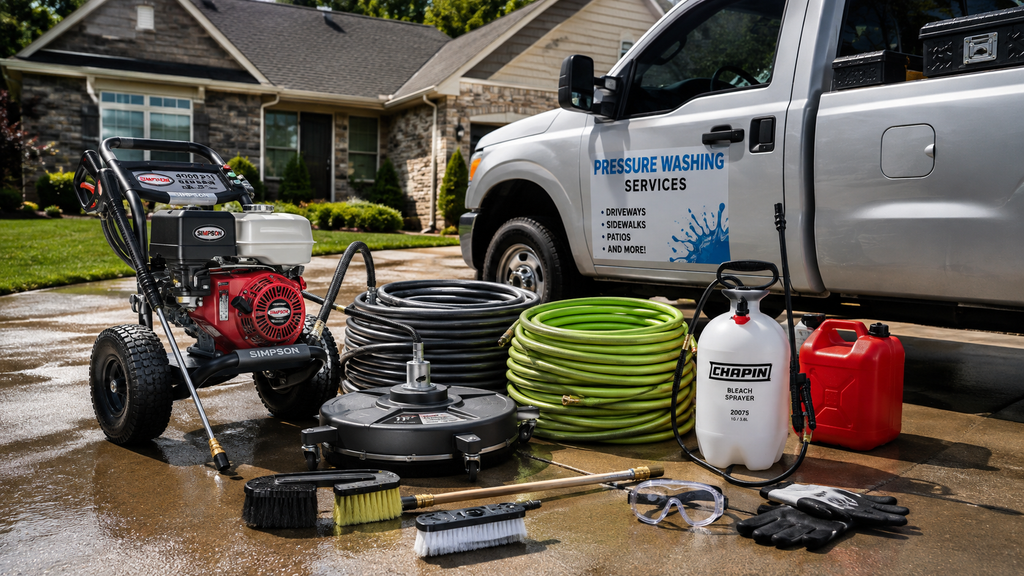
A pressure washing equipment checklist can help you figure out what you actually need to start a pressure washing business without spending thousands of dollars on equipment you may not need yet.
When you look at established pressure washing companies, you may see large trailers with commercial pressure washers, water tanks, hose reels, surface cleaners, chemical tanks, and other professional equipment. That can make starting a pressure washing business seem much more expensive than it needs to be.
The good news is that you don’t need the ultimate pressure washing rig on day one.
A beginner can start with the essential equipment needed to safely clean driveways, sidewalks, patios, and other common residential surfaces. As your customer base grows, you can upgrade your equipment and add specialized services.
This guide breaks down the essential pressure washing equipment for beginners, what you can wait to buy, and how to build a practical setup without overspending.
As an Amazon Associate, I earn from qualifying purchases. This article contains affiliate links, which means I may earn a commission at no additional cost to you.
What Equipment Do You Need to Start a Pressure Washing Business?
At a minimum, a pressure washing business needs equipment for:
- Producing adequate water pressure and flow
- Connecting to a customer’s water supply
- Cleaning larger flat surfaces
- Applying appropriate cleaning solutions
- Reaching different areas of a property
- Protecting yourself while working
- Transporting and organizing your equipment
Your exact setup will depend on the services you plan to offer.
For example, someone starting with residential driveway and sidewalk cleaning doesn’t need the same setup as a company offering roof cleaning, large commercial jobs, or specialized soft washing.
Start by deciding which services you want to offer.
Then purchase equipment that helps you perform those services safely and efficiently.
Beginner Pressure Washing Equipment Checklist
Here is a quick overview of the basic equipment and supplies you may need.
Main Equipment
- Gas pressure washer
- Pressure washer hose
- Spray gun and wand
- Pressure washer nozzles
- Surface cleaner
- Garden hose
Cleaning Equipment
- Downstream injector
- Chemical-resistant pump sprayer
- Cleaning solutions appropriate for the surface
- Cleaning brushes
- Measuring containers
Spare Parts and Organization
- Quick-connect fittings
- O-rings and washers
- Storage bins
- Tool bag
- Hose storage
- Approved fuel container
Safety Equipment
- Eye protection
- Chemical-resistant gloves
- Slip-resistant footwear
- Hearing protection when appropriate
- Protective clothing
- First-aid kit
You don’t necessarily need to purchase everything at once.
Let’s look at the most important pieces of equipment individually.
1. Pressure Washer
Your pressure washer is the foundation of your business.
It provides the water pressure and water flow needed to remove dirt and buildup from surfaces such as:
- Driveways
- Sidewalks
- Patios
- Concrete
- Some decks and fences
- Other appropriate exterior surfaces
When shopping for a pressure washer, beginners often focus almost entirely on PSI.
PSI measures pressure, but it isn’t the only number that matters.
You should also pay close attention to GPM, or gallons per minute.
GPM measures how much water your pressure washer can move. More water flow can help you rinse surfaces and complete larger cleaning jobs more efficiently.
For someone planning to perform paid residential pressure washing regularly, a professional-style gas pressure washer around the 3.5 GPM range or higher can provide a stronger starting point than a small homeowner machine.
A smaller pressure washer may cost less upfront, but it can also make large driveways and other jobs take considerably longer.
When comparing pressure washers, consider:
- PSI
- GPM
- Engine
- Pump
- Hose length
- Portability
- Fuel requirements
- Replacement parts
- Warranty
- Service availability
You don’t necessarily need the largest commercial machine available.
The goal is to choose equipment that can handle the type and volume of work you expect to perform.
Product Option: SIMPSON PowerShot PS60869 4000 PSI 3.5 GPM Gas Pressure Washer
The SIMPSON PowerShot PS60869 is a professional-style gas pressure washer worth considering for someone starting a pressure washing business. It delivers 4000 PSI at 3.5 GPM and includes a Honda GX270 engine, AAA triplex pump, 50-foot 3/8-inch pressure hose, spray gun, wand, and five quick-connect nozzle tips.
The 3.5 GPM water flow makes it better suited for regular residential pressure washing than smaller homeowner machines, while the included hose, gun, wand, and nozzles reduce the amount of additional equipment you need to purchase immediately.
A less expensive machine can work if your startup budget is limited. However, someone planning to clean driveways, sidewalks, patios, and other residential surfaces regularly may benefit from starting with a higher-flow professional-style machine.
Before purchasing, verify the current product specifications and included accessories.
2. Pressure Washer Hose
Your pressure washer needs a hose rated to safely handle the pressure produced by your machine.
Hose length also becomes increasingly important when you’re working professionally.
A longer pressure hose allows you to move around a property without constantly moving the pressure washer itself.
This is particularly useful when cleaning:
- Large driveways
- Long sidewalks
- Patios
- Pool decks
- Larger residential properties
When choosing a pressure washer hose, consider:
- Length
- Working pressure rating
- Diameter
- Connections
- Flexibility
- Kink resistance
The SIMPSON PowerShot PS60869 already includes a 50-foot, 3/8-inch pressure hose, so a beginner using this machine doesn’t need to immediately purchase another pressure hose.
That’s one less startup expense.
As your business grows, an additional hose can give you more working distance. A backup hose can also be useful if your primary hose becomes damaged.
For now, however, use the included hose and put that money toward equipment you actually need.
3. Pressure Washer Gun and Wand
The spray gun and wand are what you hold while pressure washing.
A new professional-style pressure washer will normally include both.
The SIMPSON machine discussed above already includes a spray gun and wand, so there is no reason for a beginner to immediately buy another set.
As your business grows, having a backup can be useful.
Professional pressure washing equipment gets used repeatedly, and a failed gun, fitting, or wand can stop an entire job.
Eventually, you may want to keep backup equipment in your truck or trailer.
For your initial setup, however, use the equipment included with your pressure washer as long as it’s appropriate for the machine and the work you’re performing.
4. Pressure Washer Nozzles
Pressure washer nozzles control the spray pattern coming from your wand.
Common nozzle colors may include:
- Red: 0-degree concentrated spray
- Yellow: 15-degree spray
- Green: 25-degree spray
- White: 40-degree spray
- Black: Low-pressure soap application
However, don’t choose a nozzle based only on its color.
The nozzle orifice size also needs to be appropriate for your pressure washer’s water flow and pressure.
Using excessive pressure or an overly concentrated spray can damage surfaces.
A narrow high-pressure stream can damage materials such as:
- Wood
- Siding
- Painted surfaces
- Mortar
- Vehicles
- Other delicate surfaces
Always match the nozzle, pressure, distance, and cleaning method to the surface you’re cleaning.
The SIMPSON pressure washer discussed above already includes five quick-connect nozzle tips, so there’s no reason to add another nozzle set to your initial equipment budget.
That’s another item you can upgrade or replace later if needed.
5. Surface Cleaner
If you plan to clean driveways, sidewalks, patios, or other large flat surfaces, a surface cleaner can become one of the most valuable tools in your setup.
Instead of cleaning concrete one narrow strip at a time with the wand, a surface cleaner uses rotating spray nozzles underneath a circular housing.
This can help you:
- Clean larger areas faster
- Produce more even results
- Reduce visible cleaning lines
- Reduce overspray
- Improve job efficiency
For a pressure washing business, time matters.
If a surface cleaner allows you to complete a driveway faster while still producing good results, you may be able to complete more work during the day.
However, bigger isn’t automatically better.
The surface cleaner needs to be properly matched to the water flow of your pressure washer.
For a 3.5 GPM machine, I would stay around the 15- to 16-inch range rather than purchasing a very large surface cleaner designed for a higher-flow commercial machine.
Product Option: SIMPSON 15-Inch Surface Cleaner
The SIMPSON 15-inch surface cleaner is a practical size to consider for a beginner residential pressure washing setup.
A surface cleaner around this size can work well for common residential flatwork such as:
- Driveways
- Sidewalks
- Patios
- Other appropriate concrete surfaces
Before purchasing, check the exact model’s maximum pressure, connection type, and manufacturer requirements to make sure it is compatible with your pressure washer.
Don’t buy the largest surface cleaner you can find simply because it covers more area. Your pressure washer needs enough water flow to operate it effectively.
6. Garden Hose
Your garden hose supplies water from the customer’s outdoor faucet to your pressure washer.
It may seem like a minor piece of equipment, but adequate water supply is important.
When choosing a garden hose, consider:
- Diameter
- Length
- Durability
- Kink resistance
- Connections
For mobile service work, a longer hose gives you more flexibility when the customer’s water source isn’t located near the area you’re cleaning.
Product Option: Flexzilla 5/8-Inch Garden Hose
The Flexzilla 5/8-inch Garden Hose is one option to consider for supplying water to a mobile pressure washing setup.
For professional residential work, a 75- or 100-foot hose can provide more flexibility than a short household garden hose.
Choose the length that makes sense for the properties you expect to service, and make sure the customer’s water source provides adequate flow for your pressure washer.
You can also carry a shorter hose if you want additional flexibility without always unrolling the longest hose.
7. Quick-Connect Fittings and Spare O-Rings
Some of the least expensive items in your pressure washing setup can cause some of the biggest headaches.
A damaged O-ring, washer, or fitting can create a leak or prevent equipment from connecting properly.
Consider keeping spare:
- Quick-connect fittings
- O-rings
- Washers
- Adapters
in your vehicle.
You don’t need a huge collection when you’re starting.
A small organizer containing spare parts that fit your specific equipment is much more useful than buying a large universal kit filled with fittings you may never use.
Once you have your pressure washer and other equipment, identify the connections your setup actually uses and purchase the appropriate spares.
8. Downstream Injector
A downstream injector allows compatible cleaning solutions to be introduced into the water stream after the pressure washer pump.
This can be useful for applying appropriate cleaning solutions at lower pressure.
However, chemical application requires more knowledge than simply connecting an injector and spraying.
You need to understand:
- Chemical compatibility
- Dilution
- Surface compatibility
- Landscaping protection
- Personal protective equipment
- Proper rinsing
- Safe chemical storage and handling
Never assume a cleaning solution is appropriate for every surface.
The downstream injector also needs to be properly matched to your equipment.
Product Option: General Pump 100775 High Draw Downstream Chemical Injector
The General Pump 100775 High Draw Downstream Chemical Injector is designed for machines in approximately the 3–5 GPM range, which makes it a logical option to consider with a 3.5 GPM pressure washer.
Matching the injector to the machine’s water flow is important because an incorrectly sized injector may not draw cleaning solution properly.
Before purchasing, verify compatibility with your pressure washer, fittings, hoses, and the cleaning products you intend to use.
9. Chemical-Resistant Pump Sprayer
A pump sprayer can be useful when you need to apply an appropriate cleaning solution to a smaller or targeted area without running it through your pressure washing system.
Possible uses include:
- Spot treatments
- Small cleaning areas
- Pre-treatment
- Specialized cleaning applications
However, a standard lawn-and-garden sprayer isn’t automatically suitable for the cleaning products used by pressure washing businesses.
Some chemicals can damage seals, hoses, and other components that aren’t designed to handle them.
Product Option: CHAPIN 20075 1-Gallon Bleach Pump Sprayer
The CHAPIN 20075 1-Gallon Bleach Pump Sprayer is designed for cleaning and disinfecting applications involving compatible bleach solutions, making it a more practical option to consider than a basic lawn-and-garden sprayer.
A one-gallon size is also manageable for a beginner who needs a separate sprayer for smaller treatment areas without investing in a large commercial sprayer.
Always check the manufacturer’s chemical-compatibility information before use. Clearly label your sprayers, follow the cleaning product’s dilution and safety instructions, and never mix incompatible chemicals.
10. Cleaning Brushes
Not every stain should be attacked with additional pressure.
Sometimes a brush and an appropriate cleaning product are better tools.
Brushes may be useful for certain cleaning tasks involving:
- Stubborn spots
- Outdoor furniture
- Detail work
- Corners
- Areas a surface cleaner can’t reach
Keep brushes used for different chemicals or dirty applications separate.
You don’t need an expensive collection when you’re starting.
A few durable brushes in different sizes can handle many common jobs.
This is another category where you don’t need to buy a particular product just because you’re starting a business.
11. Hose Reels
Hose reels aren’t necessary before you book your first pressure washing job.
You can manually coil your hoses when you’re starting.
However, hose reels can eventually make setup and breakdown much faster.
They can also help:
- Keep hoses organized
- Reduce tangles
- Protect equipment
- Create a cleaner truck or trailer setup
Larger professional rigs may use separate reels for:
- Garden hose
- Pressure hose
- Soft wash hose
But there’s no reason to immediately build a large multi-reel setup.
Start simple.
Once you’re completing enough jobs that hose management is wasting significant time, you’ll have a much better reason to invest in reels.
12. Safety Equipment
Safety equipment is essential when working with high-pressure water, gasoline-powered equipment, and cleaning chemicals.
Your setup may include:
- Safety glasses or goggles
- Chemical-resistant gloves
- Slip-resistant footwear
- Protective clothing
- Hearing protection when appropriate
- First-aid kit
Pressure washing can send dirt, stones, and other debris into the air.
Cleaning chemicals create additional risks.
Always follow the pressure washer manufacturer’s instructions and the safety requirements for any cleaning products you’re using.
Product Option: DEWALT DPG82 Concealer Safety Goggles
The DEWALT DPG82 Concealer Safety Goggles are one eye-protection option to consider when working around water, debris, and cleaning equipment.
Your safety equipment should always match the actual hazards of the job.
If you’re working with cleaning chemicals, check the product label and Safety Data Sheet for information about appropriate personal protective equipment.
13. Fuel Container
If you’re using a gas-powered pressure washer, you’ll need a safe way to transport fuel.
Use an approved fuel container and follow applicable storage, transportation, and equipment safety requirements.
Never transport fuel in an inappropriate container or leave it unsecured where it can tip or leak.
Fuel also becomes part of your operating cost.
As you begin pricing jobs, remember that your expenses include more than cleaning chemicals.
You may also be paying for:
- Gasoline for the pressure washer
- Fuel for your vehicle
- Equipment maintenance
- Replacement parts
- Insurance
- Advertising
- Other business overhead
These costs should eventually be reflected in your pricing.
14. Storage and Organization
Organization becomes increasingly important as you add equipment.
A basic pressure washing setup can quickly accumulate:
- Nozzles
- Fittings
- O-rings
- Tools
- Brushes
- Chemicals
- Hoses
- Safety equipment
- Spare parts
Use storage bins or tool organizers to keep small items together.
Keep chemicals properly labeled and secured.
Keep spare fittings and repair items somewhere you can reach quickly.
You don’t need a custom pressure washing trailer immediately.
A simple, organized truck or trailer setup can work perfectly well while you’re building your business.
Equipment You Don’t Necessarily Need on Day One
Looking at established pressure washing businesses online can make it seem like you need an expensive professional trailer before taking your first customer.
You don’t.
Depending on the services you’re offering, you may be able to wait before purchasing:
- Large buffer tank
- Dedicated water tank
- Multiple hose reels
- Dedicated soft wash system
- Large chemical tanks
- Custom pressure washing trailer
- Second pressure washer
- Hot-water pressure washer
- Large commercial surface cleaner
- Remote chemical systems
- Specialized roof-cleaning equipment
These upgrades can be valuable once your business has enough customers and revenue to justify them.
Start with equipment that helps you perform the jobs you’re actually selling.
Then let your business revenue help pay for upgrades.
Do You Need a Water Tank When Starting?
Not necessarily.
Many beginner pressure washing businesses use the customer’s outdoor water supply.
That can dramatically simplify your first setup because you don’t immediately need:
- Water tank
- Tank plumbing
- Additional pumps
- Larger trailer
- Tank mounting equipment
A buffer tank or onboard water supply may become useful as your equipment, water-flow requirements, and business grow.
But water adds significant weight.
One gallon of water weighs approximately 8.3 pounds.
That means:
| Water | Approximate Weight |
|---|---|
| 100 gallons | 830 pounds |
| 200 gallons | 1,660 pounds |
| 300 gallons | 2,490 pounds |
And that’s just the water.
You still need to account for the weight of the:
- Tank
- Trailer
- Pressure washer
- Hoses
- Surface cleaner
- Chemicals
- Fuel
- Tools
- Other equipment
Before adding a water tank, verify that your vehicle and trailer can safely handle the complete loaded setup.
Should You Start With a Trailer?
A trailer can make transporting pressure washing equipment easier, but you don’t necessarily need one to start.
If your pressure washer, hoses, surface cleaner, chemicals, and other basic equipment safely fit in your existing vehicle, you may be able to begin without purchasing a trailer.
A trailer becomes more useful as you add:
- Water or buffer tanks
- Multiple hose reels
- Larger pressure washers
- Chemical tanks
- Soft wash equipment
- Additional tools
There can actually be an advantage to waiting.
After completing real customer jobs, you’ll have a much better idea of how you want your equipment arranged.
Instead of building an expensive trailer around what another pressure washing company uses, you can build one around your own workflow and services.
Now that we’ve covered the essential equipment needed for a basic pressure washing setup, let’s look at the equipment you may want to add as your business grows.
Some of these upgrades can make jobs faster, help you offer additional services, or make your setup more professional. However, most beginners do not need to purchase all of them before getting their first customers.
The goal should be to start with enough equipment to perform your initial services properly and then reinvest some of your revenue into upgrades that make sense for your business.
Do You Need Soft Washing Equipment?
Not necessarily when you’re first starting.
Pressure washing and soft washing are related, but they aren’t the same thing.
Pressure washing relies more heavily on water pressure to clean appropriate hard surfaces. Soft washing uses lower pressure along with cleaning solutions to clean surfaces that could potentially be damaged by excessive pressure.
Soft washing methods may be used for certain applications involving:
- Siding
- Stucco
- Painted surfaces
- Some fences
- Other surfaces requiring lower-pressure cleaning methods
Roof cleaning is another service commonly associated with soft washing, but it introduces additional chemical, property-protection, fall, and application considerations.
A dedicated soft wash system may eventually include:
- Chemical-resistant pump
- Battery
- Chemical tank
- Hose
- Hose reel
- Spray gun
- Appropriate fittings
- Proportioning or mixing equipment
That can add considerably to your startup costs.
If you’re beginning with services such as driveway, sidewalk, patio, and appropriate concrete cleaning, you may not need a complete dedicated soft wash system immediately.
Learn how to safely perform the services you’re already offering before expanding into more specialized work.
Do You Need a Buffer Tank?
A buffer tank can become useful as your equipment and business grow, but many beginners don’t need one immediately.
A buffer tank holds water between the customer’s water source and your pressure washer.
One reason businesses use buffer tanks is to help provide a more consistent water supply to higher-flow equipment when the customer’s water source cannot keep up with the machine’s demand.
With the 3.5 GPM pressure washer discussed in Part 1, many residential water supplies may provide enough water for the machine.
However, you should never simply assume that every property has adequate water flow.
As you move into larger machines and higher GPM equipment, water supply becomes increasingly important.
A buffer tank also adds:
- Cost
- Plumbing
- Weight
- Space requirements
- Additional setup considerations
For a beginner using a portable pressure washer and customer-supplied water, this is usually an upgrade you can consider later.
Do You Need a Water Tank?
A dedicated water tank and a buffer tank aren’t always being used for exactly the same purpose.
Some pressure washing businesses carry substantial amounts of water so they can work where an adequate water source isn’t readily available.
That can sound convenient, but carrying water changes your entire setup.
Remember that water weighs approximately 8.3 pounds per gallon.
A 200-gallon tank filled with water contains roughly:
200 × 8.3 = 1,660 pounds of water
A 300-gallon tank contains roughly:
300 × 8.3 = 2,490 pounds of water
Then you still have to account for:
- Tank
- Trailer
- Pressure washer
- Fuel
- Surface cleaner
- Hoses
- Chemicals
- Hose reels
- Tools
- Other equipment
That’s why a beginner shouldn’t randomly purchase a large tank and put it on a trailer without understanding payload, towing, trailer, axle, mounting, and other safety requirements.
If you can use the customer’s water supply for the services you’re offering, you may be able to avoid this expense entirely when you’re starting.
Do You Need a Hot-Water Pressure Washer?
For most beginners doing basic residential work, no.
A hot-water pressure washer can be useful for certain commercial and heavy-duty cleaning applications, particularly when dealing with substances such as oil and grease.
However, hot-water equipment is generally:
- More expensive
- Heavier
- More complicated
- More costly to maintain
If your first customers are hiring you for residential driveways, sidewalks, patios, and similar services, a quality cold-water pressure washer can be a much more practical place to start.
If you eventually begin taking commercial jobs where hot water provides a meaningful advantage, you can evaluate the investment then.
Do You Need a Second Pressure Washer?
Not when you’re just starting.
One reliable machine is enough for most new pressure washing businesses.
However, a backup machine becomes much more valuable once you’re working regularly.
Imagine having several jobs scheduled for the week and your pressure washer suddenly needs a repair.
Without a backup, you may have to:
- Reschedule customers
- Lose revenue
- Delay jobs
- Pay for emergency repairs
- Rent another machine
That’s why established businesses often keep backup equipment.
But you don’t need to spend thousands of dollars preparing for every possible equipment failure before you’ve even built a customer base.
Start with one dependable machine.
Maintain it properly.
Then consider using some of your business profits to purchase a backup once your schedule becomes busy enough that downtime would seriously affect your income.
Do You Need Hose Reels?
We touched on hose reels in Part 1, but they’re worth discussing as an upgrade because they can make a noticeable difference in your workflow.
When you’re starting, you can manually coil your pressure hose and garden hose.
That costs almost nothing.
Once you’re completing multiple jobs regularly, however, repeatedly rolling and unrolling hoses can become frustrating and time-consuming.
Hose reels can help:
- Speed up setup
- Speed up breakdown
- Keep hoses organized
- Reduce tangles
- Protect hoses during transportation
- Make your truck or trailer easier to work from
A professional setup may eventually have separate reels for different hoses.
But this is a good example of an upgrade that can be purchased after the business starts generating revenue.
Do You Need a Dedicated Pressure Washing Trailer?
A dedicated trailer can eventually become one of the biggest upgrades to your pressure washing setup.
A trailer gives you room to permanently organize equipment such as:
- Pressure washer
- Buffer tank
- Water tank
- Hose reels
- Surface cleaner
- Chemical tanks
- Soft wash equipment
- Storage
- Spare parts
A well-designed trailer can significantly reduce setup and breakdown time.
But a trailer also adds expenses.
Depending on your setup, those may include:
- Trailer purchase
- Registration
- Tires
- Maintenance
- Equipment mounting
- Storage
- Security
- Additional fuel consumption
- Insurance considerations
That’s why I wouldn’t make a trailer the first purchase for every beginner.
If your basic equipment can safely fit in a truck, van, or other appropriate vehicle, you may be able to start earning money first.
Then you can build a trailer around what you’ve learned from actual customer jobs.
What Should a Beginner Pressure Washing Setup Look Like?
A beginner setup doesn’t have to look like a professional trailer you see on social media.
A practical starter setup could be as simple as:
| Equipment | Beginner Setup |
|---|---|
| Pressure Washer | 3.5 GPM professional-style gas machine |
| Pressure Hose | 50-foot hose included with machine |
| Garden Hose | 75–100 feet |
| Surface Cleaner | Approximately 15 inches |
| Nozzles | Included with pressure washer |
| Spray Gun/Wand | Included with pressure washer |
| Chemical Application | Downstream injector |
| Small Chemical Application | Chemical-compatible pump sprayer |
| Spare Parts | O-rings, fittings and washers |
| Safety Equipment | Eye, hand, foot and hearing protection as appropriate |
| Storage | Basic bins or tool organizers |
| Water Source | Customer’s water when appropriate |
| Transportation | Existing suitable vehicle if possible |
That’s enough equipment to begin building a useful residential pressure washing setup without immediately purchasing tanks, multiple reels, or a custom trailer.
Beginner Setup vs. Upgraded Professional Setup
As your business grows, your equipment may gradually change.
| Beginner Setup | Upgraded Setup |
|---|---|
| One pressure washer | Primary + backup machine |
| 3.5 GPM machine | Higher-flow commercial machine |
| Customer water supply | Buffer tank when needed |
| Manually coiled hoses | Hose reels |
| Portable equipment | Mounted equipment |
| Basic chemical application | More advanced chemical system |
| Small surface cleaner | Surface cleaner matched to upgraded machine |
| Existing vehicle | Dedicated truck or trailer |
| Basic storage bins | Permanent organized storage |
| Limited service menu | Additional specialized services |
You don’t need to jump from the left column to the right column all at once.
Upgrade when a piece of equipment will help you save time, complete more jobs, reduce downtime, or offer a profitable new service.
How Much Does Pressure Washing Equipment Cost for a Beginner?
Startup costs can vary considerably depending on the quality of equipment you purchase and what you already own.
For example, someone who already has a suitable vehicle, garden hose, safety equipment, and basic tools may spend considerably less than someone starting from nothing.
Here’s a simple planning example:
| Equipment | Example Planning Range |
|---|---|
| Professional-style gas pressure washer | $700–$1,200+ |
| Surface cleaner | $75–$250+ |
| Garden hose | $40–$100+ |
| Downstream injector | $20–$60+ |
| Pump sprayer | $20–$50+ |
| Spare fittings/O-rings | $20–$50+ |
| Safety equipment | $50–$150+ |
| Brushes/small tools | $25–$75+ |
| Storage/organization | $25–$100+ |
| Initial cleaning supplies | $50–$150+ |
A basic setup using these planning numbers could land somewhere around $1,000 to $2,000 or more, depending heavily on the pressure washer and equipment you choose.
These are planning examples, not guaranteed retail prices. Equipment prices change, and you may spend more or less.
You also don’t have to purchase every item at the same time.
Don’t Forget the Business Costs
Equipment isn’t your only startup expense.
Someone starting a pressure washing business may also need to budget for things such as:
- Business registration
- Local licenses or permits when required
- Liability insurance
- Vehicle expenses
- Fuel
- Marketing
- Website or domain
- Business phone
- Payment processing
- Equipment maintenance
- Replacement parts
- Cleaning products
- Protective equipment
This is why it’s helpful to calculate your complete startup cost instead of looking only at the price of the pressure washer.
What Should You Buy First If Money Is Limited?
If you have a limited startup budget, prioritize equipment that allows you to actually complete your first paying jobs.
A simple purchasing order might look like this:
1. Pressure Washer
This is your primary piece of equipment.
Spend more of your budget here rather than buying a cheap machine and immediately spending money on accessories you don’t need.
2. Water Supply Hose
You need a reliable way to connect to the customer’s water source.
3. Surface Cleaner
If you’re planning to sell driveway, sidewalk, and patio cleaning, a properly matched surface cleaner can make those jobs much more efficient.
4. Basic Chemical Application Equipment
Add an appropriate downstream injector and/or chemical-compatible sprayer based on the services you’re offering.
5. Safety Equipment
Safety equipment isn’t something to postpone simply because it doesn’t directly make money.
6. Spare Parts
O-rings, washers, and basic fittings are inexpensive compared with losing a job because of a minor equipment problem.
Then add convenience upgrades such as hose reels, larger storage systems, tanks, and trailers later.
Common Pressure Washing Equipment Buying Mistakes
Buying equipment is exciting when you’re starting a business.
It’s also very easy to overspend.
Here are some common mistakes to avoid.
Buying Based Only on PSI
A machine advertising a huge PSI number isn’t automatically better for a pressure washing business.
Pay attention to GPM, pump quality, engine, durability, parts availability, and the type of work the machine is designed to perform.
Buying Too Small
A small homeowner pressure washer may technically clean a driveway.
But if it makes every job take much longer, the low purchase price may not be much of a bargain for a business.
Buying Too Big Too Soon
The opposite problem happens too.
You don’t need the biggest pressure washer, largest surface cleaner, huge water tank, and custom trailer before getting your first customer.
Match your equipment to the work you’re actually performing.
Buying an Oversized Surface Cleaner
A large surface cleaner requires adequate water flow.
Pairing a large surface cleaner with a lower-GPM pressure washer may result in poor cleaning performance.
Match the surface cleaner to your machine.
Buying Equipment That Doesn’t Work Together
This is one of the easiest mistakes for beginners to make.
Before purchasing an accessory, check:
- Pressure rating
- GPM requirements
- Connection sizes
- Hose diameter
- Nozzle requirements
- Chemical compatibility
Individual pieces of equipment may be good products but still be a poor combination.
Buying a Trailer Before You Know What You Need
It can be tempting to build a professional-looking trailer immediately.
After completing 20 or 30 real jobs, however, you may discover that you want your equipment arranged completely differently.
There’s nothing wrong with starting simple.
Spending Too Much on Appearance
A polished business image is important, but customers are primarily paying you to produce good results and provide reliable service.
Your first setup doesn’t need to look like a $20,000 professional rig.
Keep it clean, organized, safe, and functional.
Don’t Forget Equipment Maintenance
Your equipment is what allows you to earn money.
Take care of it.
Follow the manufacturer’s maintenance schedule for your pressure washer and other equipment.
Depending on your machine, maintenance may include:
- Checking engine oil
- Changing engine oil
- Inspecting hoses
- Checking fittings
- Inspecting O-rings
- Checking filters
- Maintaining the pump
- Inspecting nozzles
- Cleaning equipment after use
- Proper winterization where necessary
Also inspect your equipment before jobs.
Finding a damaged hose or leaking fitting at home is much better than discovering it after arriving at a customer’s property.
As your business grows, consider keeping a small maintenance and repair budget.
Calculate Your Pressure Washing Startup Costs
Before purchasing everything on your pressure washing equipment checklist, add up the complete cost of getting your business ready to operate.
Our Pressure Washing Startup Cost Calculator can help you estimate how much money you may need for equipment, supplies, business expenses, and other startup costs.
You can also use the other Pressure Washing Calculators on Service Calculator Hub to estimate:
- What to charge per job
- Your hourly rate
- Cost per job
- Profit per job
- Daily income
- Monthly income
- Break-even point
- Price per square foot
Equipment is only one part of building a profitable pressure washing business.
You also need to know what each job costs you and how much you need to charge to reach your profit goals.
Frequently Asked Questions
What equipment do I need to start a pressure washing business?
A basic beginner setup may include a gas pressure washer, pressure hose, garden hose, spray gun and wand, nozzles, surface cleaner, chemical application equipment, basic cleaning supplies, spare fittings, and appropriate safety equipment.
You may be able to use the customer’s water supply and your existing suitable vehicle when you’re starting, which can help reduce startup costs.
How many GPM should a pressure washer have for a beginner business?
There isn’t one required GPM for every pressure washing business, but water flow affects how efficiently you can clean and rinse.
For the beginner setup discussed in this guide, we’re using a 3.5 GPM professional-style gas pressure washer as an example. Smaller machines can work, but lower water flow may increase the amount of time required for larger residential jobs.
Do I need a water tank to start a pressure washing business?
Not always.
Many beginners use the customer’s outdoor water supply. A buffer tank or dedicated water tank can be added later if your equipment, customer water supply, or services make one necessary.
Remember that water is heavy, so vehicle and trailer weight limits need to be considered before adding a large tank.
Do I need a trailer to start a pressure washing business?
No. If your equipment can be transported safely in an appropriate vehicle, you may be able to begin without a dedicated trailer.
A trailer can become useful later when you add tanks, hose reels, larger equipment, or a dedicated soft wash system.
How much should I spend on pressure washing equipment when starting?
A beginner might spend around $1,000 to $2,000 or more on a basic setup depending on equipment quality, what they already own, and the services they plan to offer.
A more advanced trailer-based setup can cost considerably more.
Instead of trying to buy everything immediately, prioritize equipment needed to perform your first profitable services.
Final Thoughts
A pressure washing equipment checklist doesn’t need to include every piece of equipment used by an established professional company.
For most beginners, it’s better to start with a dependable pressure washer, properly matched surface cleaner, adequate hoses, basic chemical application equipment, safety gear, and a small collection of spare parts.
You can add water tanks, hose reels, dedicated soft wash equipment, backup machines, and a custom trailer as your business grows.
The goal isn’t to have the most impressive pressure washing setup on your first day.
The goal is to have a safe, practical setup that allows you to complete quality work, get paying customers, and gradually reinvest in better equipment as your business grows.
Disclaimer: The calculators, guides, and estimates provided on Service Calculator Hub are for informational and educational purposes only. Actual prices, costs, profits, and income may vary based on location, experience, market conditions, materials, labor costs, and individual business circumstances. Always conduct your own research and use your professional judgment when pricing services or making business decisions.